

Major adjustments have taken place in US fiscal and monetary policy recently, and the sustained accommodative policy stance has delivered strong support for precious‑metal markets.
On the evening of August 19, 2026 Beijing time, the US Treasury officially rolled out expanded repurchases of long‑dated Treasury bonds, a move regarded by markets as stealth quantitative eASIng. Charlie Morris, Founder and Chief Investment Officer of ByteTree, stated in his latest industry report that the resonance of multiple US eASIng measures has thoroughly laid the foundation for gold’s bull market. The current gold rally is only the beginning, with ample upside remaining. Debt imbalances, monetary eASIng and global central‑bank gold purchases will keep driving gold prices higher.
US Treasury Rolls Out Stealth EASIng to Actively Lower Financing Costs
Led by US Treasury Secretary Scott Bessent, the core policy change doubles the scale of long‑term Treasury buy‑backs, aiming to prop up long‑bond prices and reduce the US government’s long‑term financing costs.
According to Morris, this operation is essentially equivalent to quantitative eASIng and represents a key tool for the US government to actively intervene in bond markets and offset debt pressures. Prior to this, Bessent had deployed billions of US dollars in late‑July foreign‑exchange intervention to stabilise the Japanese yen. This series of eASIng operations injected continuous liquidity and acted as the direct trigger for gold’s bottom‑turn rebound.

In his report, he offered an upbeat outlook for gold: “Gold’s overall trend is improving and market sentiment is rapidly warming. Gold will soon re‑establish itself above the 200‑day moving average.” Compared with conventional monetary policy, Treasury direct bond purchases deliver more immediate eASIng effects. Sustained liquidity injections provide solid backing for gold’s safe‑haven‑premium valuation.
Uncontrolled US Treasury Debt Leaves Huge Room for Gold Valuation Re‑rating
US public debt has now exceeded $40 trillion, with debt expansion accelerating. Data show US debt grew at an annual rate of 3.7% in the 1990s, rising to 7.8% pre‑pandemic and further climbing to 8.6% after the pandemic. This outpaces the 6.5% nominal US GDP growth rate. Such long‑term fiscal imbalance is unsustainable.
Morris analysed that the total market value of above‑ground global gold has maintained deep correlation with outstanding US government debt over the past century. Annual physical gold output expands by only 2%, so gaps created by debt expansion can only be filled by higher gold prices. The total market value of global gold stands at roughly $31 trillion, equal to 77% of US Treasury debt. Historically this ratio has repeatedly surpassed 100%, leaving room for gold valuation recovery. Meanwhile, gold’s market cap equals merely 37% of total US stock‑market capitalisation, far below the 160% peaks seen during the Great Depression and the 1970s inflation crisis, implying substantial upside potential ahead.
Drawbacks Hidden Within EASIng Policies, Central‑Bank Gold‑Buying Thesis Strengthened
Industry participants note clear flaws in the US model of sustained bond‑buying eASIng. The stock of long‑dated bonds is far smaller than short‑dated issues. While bond repurchases can depress long‑term yields, policymakers must keep scaling up operations to sustain eASIng effects. In the current re‑inflation environment, negative side‑effects of this model will keep amplifying. In addition, the US faces $3 trillion of short‑term debt refinancing pressure from 2027 to 2028, making peRSIstently low interest rates and ample liquidity an inevitable policy choice for Washington.
This explains why global central banks keep raising gold allocations. According to Morris, central banks are gradually reducing reliance on US Treasuries. Gold, with its large market depth, strong liquidity, scarce supply and long‑term value‑preserving properties, represents the optimal alternative asset. Global central‑bank gold‑buying rebounded sharply in Q1 this year, with only Turkey and Russia seeing temporary net sales. Massive annual trade surpluses across large ASIan economies keep channelling capital into gold markets. Amid shifting geopolitical landscapes, gold has become a core global safe‑haven asset.
Conclusion
All in all, the US Treasury’s ongoing stealth quantitative‑eASIng measures, together with runaway US debt and eroding US‑dollar credibility, form the core medium‑to‑long‑term bull‑case for gold. Gold valuations remain relatively low at present. Combined with peRSIstent central‑bank purchases and ongoing geopolitical disturbances, multiple positive drivers have jointly opened gold’s upside channel, pointing to strong continuity and further room for price appreciation.
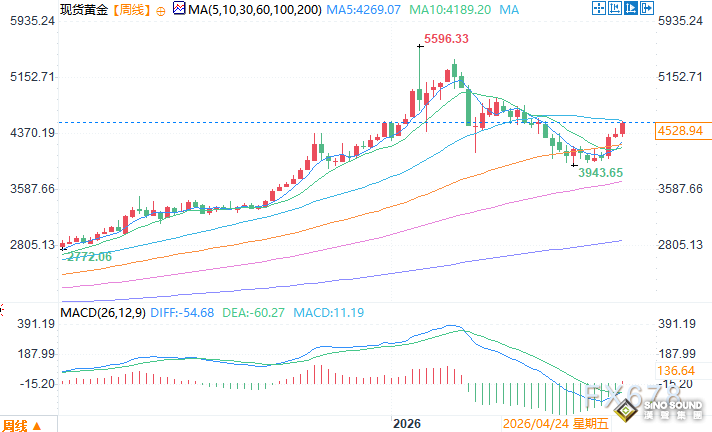
Spot Gold Weekly Chart, Source: Yihuitong
Spot gold quoted at $4527.54 per ounce at 10:35 Beijing Time, August 21.