

Driven by fading market expectations for a September Fed rate hike, gold advanced further this week, though its upside was periodically capped by a stronger U.S. dollar, rising oil prices and profit‑taking. Spot gold opened the week at $4,342.50 per troy ounce and climbed steadily ahead of U.S. inflation data. It accelerated after July’s Consumer Price Index (CPI) largely matched forecasts on Wednesday, touching a 10‑week high intraday and peaking at $4,450.23 on Thursday. In early Friday trade, gold pulled back to a weekly low of $4,311.22 amid soft wholesale‑inflation figures, climbing oil prices and higher U.S. Treasury yields. However, expectations for unchanged September rates surged again following an unexpected 0.6% month‑on‑month drop in U.S. retail sales. Gold recouped its losses to close the week marginally higher.
Spot gold settled Friday at $4,375.85 per troy ounce, gaining $34.48 or 0.79% over the week.
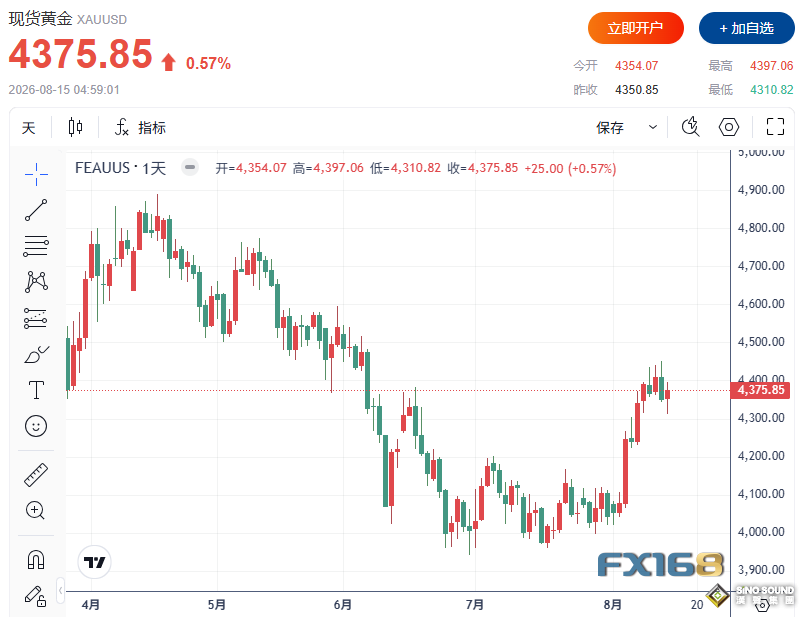
(Source: FX168)
Wall‑Street Is Almost Uniformly Bullish
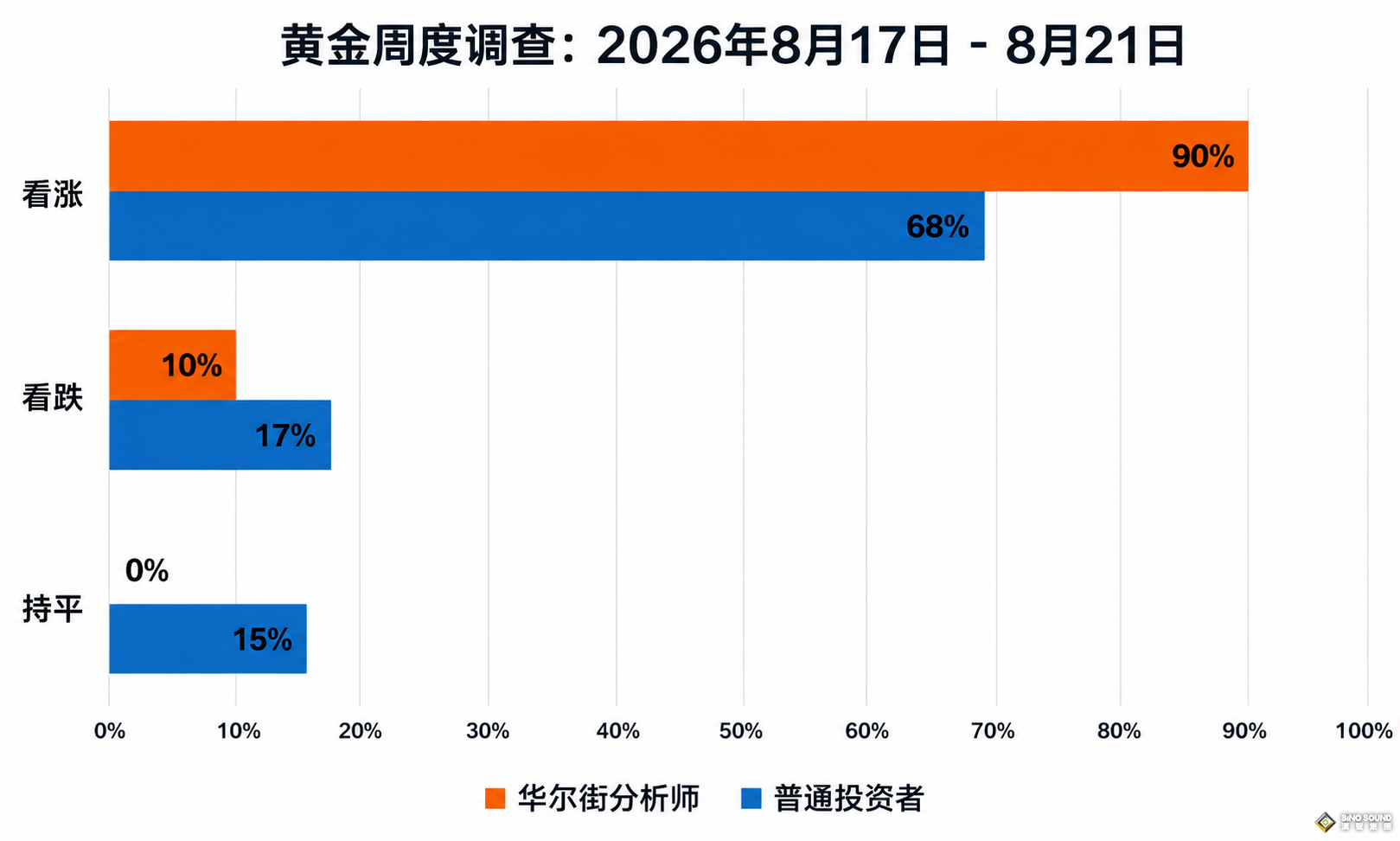
The latest Kitco News weekly gold survey shows Wall‑Street professionals have turned markedly optimistic toward gold’s outlook. Nine out of ten polled analysts (90%) predicted higher gold prices next week; only one was bearish and none called for sideways movement. Among 222 retail‑investor respondents, 150 (68%) were bullish, 38 (17%) bearish, and 34 (15%) expected consolidation.
Adrian Day, President of Adrian Day Asset Management, sees gold edging “moderately higher” in the short‑term yet trading within a range amid tug‑of‑war between higher‑rate expectations and deteriorating fiscal conditions. While underlying support is solid, it is not yet enough to drive a decisive breakout. Darin Newsom, Senior Market Analyst at Barchart.com, holds a bearish view. He argues gold’s fundamentals remain unchanged with ongoing central‑bank support and investment capital swinging between inflows and outflows. He specifically notes the U.S. July budget deficit widened by $432 billion, marking the largest monthly shortfall since March 2021. This continues eroding global confidence in the U.S. dollar, pressuring the greenback and keeping real‑inflation concerns alive.
Cooling Data Dials Back Rate‑Hike Bets
Newsom adds that buying interest should underpin gold over the long run, yet the daily chart for December gold futures may be entering a short‑term downtrend on a technical bASIs, leaving room for a pullback next week. Marc Chandler, Managing Director at Bannockburn Global Forex, is bullish and expects gold to test the 200‑day moving average near $4,503, a level gold has failed to sustain above since the first week of June.
Rich Checkan, President and COO of Asset Strategies International, says decelerating consumer‑ and producer‑price inflation alongside net job losses and rising initial jobless claims have convinced investors the Fed will skip a rate hike at the September FOMC meeting. Gold has bounced strongly off consolidation lows near $4,000 per ounce, with a clear overall upward bias, he states.
Daniel Pavilonis, Senior Commodities Broker at StoneX Group, notes that despite gold’s two‑week rally, he does not yet see the start of a larger‑scale advance. Energy prices are driving market sentiment and trading range‑bound, as are metals. Although December gold futures have rebounded, continuous‑contract prices remain trapped above the 200‑day moving average yet below the longer‑term displaced 200‑day moving average, keeping gold in range‑bound mode.
Markets Await Stronger Catalysts
According to Pavilonis, fresh catalysts are required for a decisive breakout, and economic data alone may not suffice. A sudden sharp escalation in geopolitical tensions or some form of “momentum event” could trigger stronger gold demand. Current economic prints are neither exceptionally strong nor weak; inflation remains sticky, food prices are somewhat elevated, yet broad commodities are not excessively high. No powerful trigger exists to propel gold to fresh record highs.
He also warns on the technical front that gold may be forming a multi‑month head‑and‑shoulders top pattern. Failure to make new highs from current levels could open the way for a retest toward $3,300. Real accelerated upside for precious metals would likely require renewed inflation pressure, even market fears of “hyperinflation” or currency debasement. For now, steady bullish portfolio positioning exists, though no GameStop‑style extreme speculative frenzy has emerged.
Pavilonis observes that this week’s PPI data favours holding rates steady. The medium‑term risk may not stem from deliberate Fed tightening, but rather interest rates drifting higher amid heavier debt burdens. Thirty‑year U.S. Treasury yields above 5% illustrate mounting debt‑market strain. Gold and other metals can still be held, though over‑weighting is inadvisable at present.
Next‑Week Focus: FOMC Meeting Minutes
The coming week brings a heavy U.S. economic‑data calendar: the New York Fed manufacturing index, July housing starts and building permits, pending home sales, weekly initial jobless claims, the Philadelphia Fed manufacturing index, and Friday’s S&P Global Composite PMI flash reading. Top priority will go to the minutes from the Fed’s July 28‑29 meeting, where markets will parse officials’ views on inflation, growth and the future rate path.
James Stanley, Senior Market Strategist at Forex.com, expects gold to extend this week’s positive performance. Even amid substantial room for profit‑taking, strong buying emerged ahead of Friday’s close, signalling the current momentum‑driven breakout is not finished, he notes. Adam Button, Chief Currency Strategist at investingLive, argues that while CPI and PPI this week softened rate‑hike odds, data prints alone are not gold’s core driver.
Button pays closer attention to yen‑intervention dynamics and shifting U.S.‑dollar policy. Washington’s long‑standing strong‑dollar stance has shifted toward deliberate currency softening; the U.S. Treasury clearly views the dollar as a policy lever and is pressing Japan toward higher interest rates. He adds that July’s U.S. deficit hit a record, with a full‑year deficit projected at $2 trillion. Meanwhile, yesterday’s 30‑year Treasury auction demanded yields at their highest since 2001, illustrating the blurring boundary between elevated yields and debt risks.
FOMC minutes will carry greater‑than‑usual market weight given three dissenting votes in July, and Button intends to infer the true stance of additional committee members from the text. While sustained explosive rallies are not guaranteed short‑term, market confidence in support below $4,000 is strengthening. Holding above $4,300 would keep gold’s near‑term construct solid, and seasonal factors tend to become more supportive only in November.
Technical Picture Remains in Focus
Alex Kuptsikevich, Senior Market Analyst at FxPro, sees further upside potential for gold next week. After extending early‑August gains, spot gold reached $4,450 and some futures contracts neared $4,500 before a roughly $140 pullback. Buying returned before the weekend, confirming the pullback was short‑lived profit‑taking consistent with the technical breakout from prior‑month downtrends.
Gold needs a breather following its early‑August surge and is now approaching major resistance around the 200‑day moving average near $4,500, a former support level now turned resistance. To establish a foothold above that zone, gold must work through short‑term overbought conditions and receive more reliable fundamental signals such as further dollar weakness and prospects for looser monetary policy.
Michael Moor, Founder of Moor Analytics, maintains a bullish bias for higher prices next week. His multi‑time‑frame analysis reviews historical price levels and technical signals, noting several prior bearish reversal zones have been overcome. If current macro‑economic and technical structures peRSIst, further upside potential remains open for gold.
>