

(North America News) U.S. President Donald Trump signed a new presidential proclamation on Thursday, imposing tariffs of up to 100% on imported drones and related components, on the grounds that such products may involve national security, military‑industrial capacity and critical supply‑chain risks.
According to information released by the White House, these tariff measures target Unmanned Aircraft Systems (UAS) and their key components. The Trump administration states that drones have become vital technology for modern military and commercial applications, yet part of America’s drone and critical‑component supply still relies on overseas sources, creating supply‑chain and cybersecurity risks.
100% Maximum Tariff Covers Certain Sensitive Drones
Under the proclamation, the United States will levy a 100% ad‑valorem tariff on drones deemed highly sensitive to national security.
This category includes drones with a maximum take‑off weight above 25 kilograms, drones equipped with thermal‑imaging capabilities, corresponding drone docking stations, and selected critical components.
Drones with a maximum take‑off weight of 25 kilograms or less and without certain high‑sensitivity functions will face a 25% ad‑valorem tariff, which also applies to some other drone components.
This means the U.S. measures are not limited to large‑size drones. Instead, a multi‑tier tariff system has been built based on weight, functions, technical sensitivity and component categories.
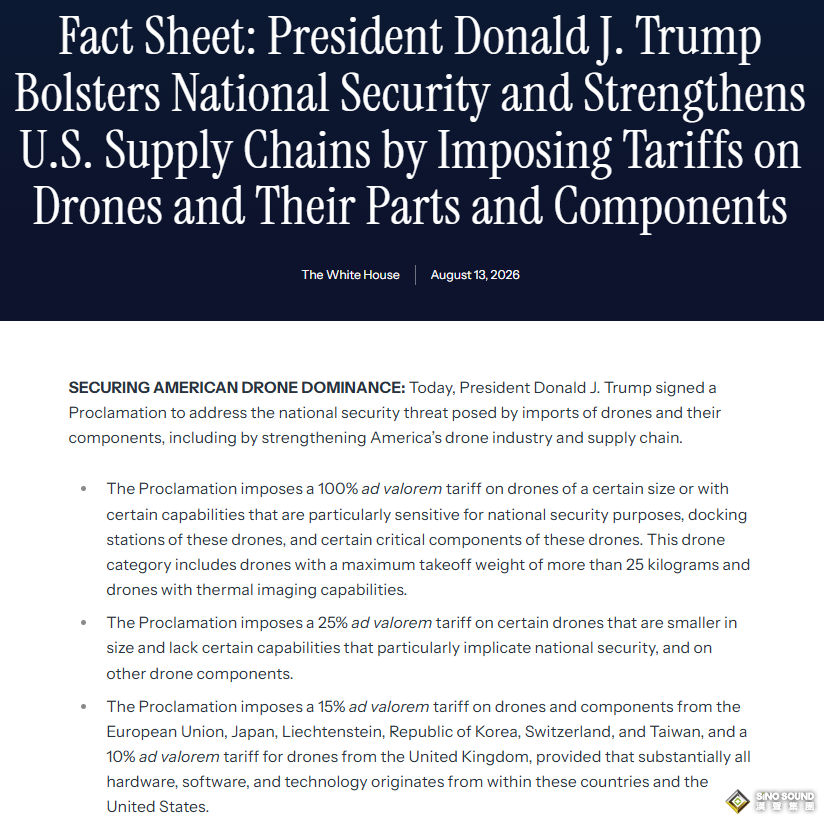
Screenshot from the official White House website
Lower Tariff Rates Apply to Certain Economies
Notably, certain economies qualify for reduced tariff rates.
Under the White House proclamation, drones and components originating from the European Union, Japan, Liechtenstein, the Republic of Korea, Switzerland and China’s Taiwan region are subject to a 15% tariff, provided that substantially all hardware, software and technology originate from those regions or the United States. Goods from the United Kingdom carry a 10% tariff.
This arrangement shows the policy is not merely designed to raise import costs; it carries clear supply‑chain restructuring objectives.
In other words, Washington intends to use differentiated tariff rates to shift more production of drone hardware, software, core technologies and critical components toward the U.S. and its partners, while lowering dependence on some overseas sources.
New Tariffs Take Effect in 21 Days in Phases
These drone tariffs will enter into force 21 days after the President signs the proclamation.
Nevertheless, not all components will immediately fall under the new tariff regime. Tariffs for some less‑sensitive drone components will be implemented 180 days after signing.
In addition, drone products or components that obtain regulatory approval and satisfy specific exemption criteria within the prescribed period after proclamation signing may also see their new tariffs deferred for 180 days.
Judging from the implementation timeline, the U.S. government clearly intends to give domestic enterprises and supply chains adjustment time via staggered effective dates, while avoiding sudden supply disruptions for certain mission‑critical products.
Promoting Reshoring of Drone Manufacturing to the United States
Beyond tariff collection, the new proclamation authorizes the U.S. Secretary of Commerce to establish a reshoring program for drone and related‑component manufacturing.
The program targets enterprises making new investments in drone and component production within U.S. territory. Its goal is to encourage more manufacturing capacity to return home and expand the domestic drone industrial chain.
The White House states that the U.S. must accelerate expansion of domestic drone‑production capacity to bolster national security and economic security.
The Trump administration also stresses that drones are widely deployed across commercial, logistics, industrial and defense sectors, and their strategic value is rising rapidly.
Accordingly, the United States increASIngly treats drones as a strategic industry comparable to chips, steel, aluminum, copper, automobiles and pharmaceuticals, rather than ordinary consumer electronics.
Section 232 Re‑deployed as a Policy Tool
This measure is built upon Section 232 of the Trade Expansion Act of 1962.
This statute empowers the U.S. government to impose tariffs or other trade restrictions when imports are deemed to threaten national security. Trump made extensive use of Section 232 to levy duties on steel and aluminum during his first term. Upon returning to office, he extended this policy instrument to copper, automobiles, trucks, lumber and pharmaceuticals.
Now drones are formally brought within the scope of this strategic‑trade tool.
The White House says the Trump administration aims to safeguard America’s defense and related industrial base while driving domestic job creation and manufacturing capacity growth.
Groundwork Laid for Drone Policy Earlier
This is not the Trump administration’s first move targeting the drone industry.
In June 2025, Trump signed an executive order calling for stronger development of the U.S. drone sector, prioritizing American‑made drones, expanding exports and mitigating external supply‑chain risks.
In the same month, he issued a further executive order focused on safeguarding U.S. airspace security and countering risks stemming from drone misuse.
The new tariff policy therefore represents an escalation of earlier industrial‑policy initiatives: extending from government procurement, exports and air‑safety rules to import tariffs and supply‑chain restructuring.
Global Drone Industrial Chain May Face Reshuffling
For the global drone industry, impacts from this policy stretch beyond higher import prices inside the United States.
Given the highly globalized drone industry, flight controllers, communication systems, camera modules, thermal‑imaging devices, motors, batteries and other aviation components are often sourced from multiple countries and regions. The strict new rules on country‑of‑origin and technology provenance may force manufacturers to reassess product origins and supply‑chain architectures.
For drone manufacturers seeking access to the U.S. market, future competition will hinge not only on product performance and pricing, but also supply‑chain provenance, ownership of core technologies and compliance with U.S. regulatory requirements.
The 100% tariff in particular is steep enough to materially alter the commercial viability of certain imported products within the U.S. market.
From this perspective, Trump’s drone tariffs are more than conventional protectionist trade measures; they amount to industrial‑chain reorganization centered on critical technologies and manufacturing capacity.
Markets will next watch which nations and enterprises secure lower‑rate treatment via localised production, partner‑based supply chains or U.S. manufacturing programs, and which drone producers are forced to restructure their global production footprints due to heavy‑duty costs.
美国对无人机加征关税的举措会对全球无人机市场产生哪些影响? 美国加征关税的关键零部件包括哪些? 美国加征关税对哪些行业会产生较大影响?