

ASIa Pacific News Wire – On Monday (August 10), Mojtaba Khamenei, Supreme Leader of Iran, issued a series of decrees to implement a major reshuffle of the country's military leadership.
Iran announced six senior personnel appointments, including the appointment of Ali Abdollahi as Chief of the General Staff of the Armed Forces, Ahmad Vahidi as Commander-in-Chief of the Islamic Revolutionary Guard Corps (IRGC), and Ali Azmaei as Commander of the IRGC Navy.
In addition, he appointed Hossein Taeb, former head of the intelligence service, to lead the BASIj Organization, a volunteer paramilitary force under the IRGC.
The decrees mandate bolstering deterrence capabilities, raising readiness for "large-scale offensive operations", and expanding domestic intelligence networks.
Mojtaba Khamenei has remained out of the public eye ever since he succeeded his father, Ayatollah Ali Khamenei, who was killed in a strike in late February 2026.
Experts stated that the military leadership reshuffle led by Supreme Leader Mojtaba Khamenei reflects the growing political clout of the IRGC and the Iranian regime’s hardline stance on negotiations with the United States.
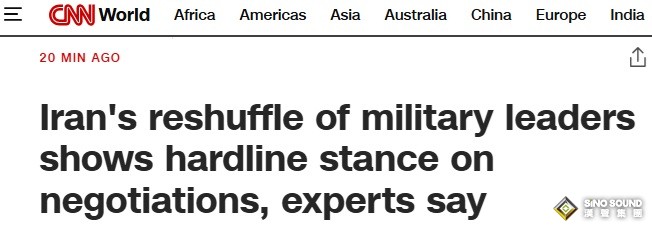
(Screenshot Source: CNN)
On Monday, Mojtaba Khamenei named Mohsen Rezaei, a veteran IRGC figure, as Iran’s national security chief, alongside six other senior military appointments.
Sina Azodi, Assistant Professor of Middle Eastern Politics at George Washington UniveRSIty, said Rezaei belongs to a faction within the IRGC that holds the view: “The only way to extract concessions from the United States is to keep fighting, keep pressuring Washington, and continuously inflict pain on President Donald Trump.”
Azodi noted Rezaei’s new post underscores the IRGC’s expanding influence and aligns with Iran’s overarching strategy: prolonging the conflict and ensuring Trump’s allies suffer defeats in the midterm elections.
Saeid Golkar, Associate Professor of Political Science at the UniveRSIty of Tennessee at Chattanooga, commented the appointments may also be a move by Khamenei to place loyal allies in pivotal power positions amid mounting economic pressures that risk triggering a new wave of domestic protests.
Golkar pointed out most of the other six appointees have backgrounds in the intelligence apparatus, highlighting Iran’s increASIng reliance on security and intelligence frameworks rather than pure military operations. He remarked: “What we are witnessing is the Islamic Republic transitioning into a bureaucratic regime dominated by its security apparatus.”
One of the newly appointed officials is Hossein Taeb, former head of Iran’s intelligence service and a close confidant of Khamenei, who will now head the BASIj militia under the Revolutionary Guard.
According to Golkar, the appointments of Taeb and Ahmad Vahidi as IRGC top commander signal Iran will maintain a confrontational posture toward the U.S. over the Strait of Hormuz. “This is by no means a signal of moderation or normalization of bilateral ties.”