

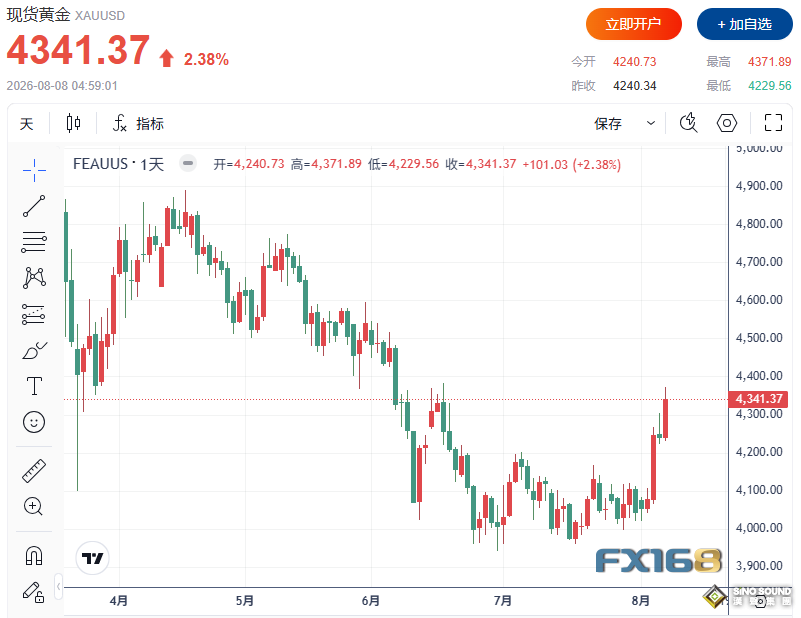
The gold market staged a powerful breakout this week. After consolidating around the $4,000 per ounce mark for nearly two months and repeatedly testing support levels, gold finally broke out to the upside. Driven by a cooling U.S. labor market, spot gold is on track to post its best weekly performance so far this year.
Spot gold closed at $4,341.37 per ounce in late U.S. trading on Friday, rising $101.03 or 2.38% on the day. It climbed 7.36% from last Friday, with a cumulative weekly gain of $297.51. Disappointing U.S. employment data served as the direct catalyst for gold’s breakout, reignishing market expectations for a Federal Reserve policy pivot.
(Source: FX168)
Negative Nonfarm Payrolls Trigger Gold’s Breakout Rally
Data released by the U.S. Bureau of Labor Statistics (BLS) on Friday showed U.S. nonfarm payrolls fell by 23,000 in July, far missing the market consensus forecast of an 85,000 increase. Meanwhile, employment readings for May and June were both revised sharply downward.
Although the U.S. unemployment rate edged down from 4.2% to 4.1% in July, analysts attributed the decline mainly to a falling labor force participation rate rather than genuine improvement in the job market. Workers exiting the workforce masked underlying weakness in labor demand.
Ahead of the official nonfarm report, the ADP private payrolls already flashed cooling signals. The ADP print showed only 44,000 new private-sector jobs created in July, undershooting market estimates and pushing spot gold to break above the $4,200 per ounce threshold for the first time.
With peRSIstent softness across labor indicators, investors rapidly repriced the Federal Reserve’s interest rate path outlook.
Hike Expectations Evaporate, Gold Gains Policy-Driven Tailwinds
Per the CME Group FedWatch Tool, the market’s implied probability of a September Fed rate hike has dropped to 42%, down from nearly 60% pricing for a 25-bASIs-point hike right before the nonfarm release.
Sluggish jobs data removes the Fed’s rationale for further monetary tightening, lowers the opportunity cost of holding non-yielding gold, and delivers extra upside momentum to bullion prices.
Waleed Said, Technical Analyst at GivTrade, commented that the jobs report is bullish for gold and broader financial markets yet poses new dilemmas for the Fed. He noted that with inflation still elevated, the central bank must recalibrate the balance between price stability and full employment.
Nevertheless, multiple analysts warned against chASIng gold’s sharp short-term rally. Even as hike bets fade, inflation remains the core metric guiding the Fed’s policy decisions.
Inflation Data to Be the Decisive Test; $4,500 Target Remains Uncertain
Roukaya Ibrahim, Head of Commodity Strategy at BCA Research, stated that gold offered compelling value near $4,000 per ounce, yet investors need to exercise caution following its over 7% weekly jump.
She pointed out that the Fed still prioritizes inflation over labor market performance. The upcoming U.S. Consumer Price Index (CPI) print due next week will serve as a critical stress test for gold’s trajectory.
A hotter-than-expected inflation reading could force the Fed to keep its restrictive policy stance longer, triggering profit-taking across gold positions.
That said, Ibrahim added she would view any gold pullback as a buying opportunity, given limited room for the Fed to reassert hawkish rhetoric, which caps further upside for real interest rates and the U.S. Dollar.
Alex Kuptsikevich, Chief Market Analyst at FxPro, shared a similar view that gold retains a positive near-term bias, though lingering inflation pressures will limit extended gains.
He explained gold recently tested the 50-week moving average, a key technical resistance level currently sitting around $4,400 per ounce. A decisive break above this level would open the door for a move toward the next major target of $4,500 per ounce.
Bulls vs. Bears Battle for Dominance Around $4,500 Post Technical Breakout
Fawad Razaqzada, Market Analyst at FOREX.com, said the weak payroll report reignited investor appetite for gold, though follow-through price action will determine the sustainability of this breakout.
In his view, lower September hike odds do not guarantee a prolonged gold uptrend. Two more CPI reports and another jobs print are scheduled before the Fed’s September meeting, while crude oil prices will also shape inflation expectations.
A rebound in energy costs that reignites inflationary pressures could push the Fed to maintain a cautious, tightening-biased stance despite labor market deterioration.
Nicky Shiels, Head of Research at MKS PAMP, issued a warning over gold’s rapid rally potentially triggering short-term profit-taking by speculative traders. She stressed that the Fed has not fully ruled out further tightening, acting as a major headwind for additional gold upside.
Shiels noted that a meaningful downside surprise in next week’s CPI report would solidify market conviction that the Fed will pause rate hikes for the rest of the year, bolstering gold’s push toward $4,500 per ounce.
Dense Economic Data Calendar Next Week Creates Critical Inflection Point for Gold
U.S. economic indicators in the coming week will be the dominant driver for gold’s price action.
Beyond CPI, the U.S. Producer Price Index (PPI), retail sales and UniveRSIty of Michigan consumer sentiment survey will all alter market pricing of the Fed’s policy roadmap.
Key upcoming releases:
Tuesday: RBA Interest Rate Decision, U.S. Pending Home Sales
Wednesday: U.S. Consumer Price Index (CPI)
Thursday: U.S. Producer Price Index (PPI), Initial Jobless Claims
Friday: U.S. Retail Sales, Preliminary UniveRSIty of Michigan Consumer Sentiment Index
Markets widely agree gold has secured a major technical breakout, yet a successful challenge of the $4,500 per ounce level hinges on incoming data reinforcing rate-cut expectations.
Caught between cooling employment data and peRSIstent inflation risks, gold bulls are awaiting the next batch of macroeconomic signals.