

During last night's US session, spot gold maintained weak consolidation, falling to a low of $4244.21 per ounce and finally closing at $4273.71 per ounce, down 0.31%. Spot silver closed at $63.807 per ounce, a drop of 0.92%. In Friday's ASIan session, spot gold opened at $4274.90 per ounce, dipped to a low of $4264.21 per ounce. Gold rebounded slightly in early trading and rose to a high of $4295.60 per ounce. At the time of writing, gold traded around $4287 per ounce, up 0.33% on the day.
The US Dollar Index traded sideways at high levels overnight, peaking at 101.40 and closing at 101.25, up 0.12%. US Treasury yields continued to surge across the board. The 2-year US Treasury yield rose by 2.7 bASIs points to close at 4.928%; the 10-year US Treasury yield climbed 8.9 bASIs points to 5.205%; the 30-year US Treasury yield increased by 8 bASIs points to 5.479%.
Tensions peRSIst between the US and Iran, and international crude oil prices closed higher for two consecutive days. WTI crude oil closed up 2.37% at $94.94 per barrel overnight; Brent crude oil rose 2.30% to settle at $100.69 per barrel. US natural gas CFD prices rose 4.658% to $3.325 per million British thermal units.
The three major US stock indexes closed mixed overnight. The Dow Jones Industrial Average fell 161.31 points, or 0.31%, to 51350.28; the S&P 500 dropped 1.67 points, or 0.02%, to 7704.36; the Nasdaq Composite gained 3.34 points, or 0.01%, to 26939.37.
Major European stock indexes all closed lower. Germany's DAX 30 fell 0.66% to 25257.80; the UK FTSE 100 lost 0.25% to 10678.90; France's CAC 40 dropped 0.52% to 8081.43; the Euro Stoxx 50 fell 0.44% to 6272.40; Spain's IBEX 35 declined 0.31% to 19570.36; Italy's FTSE MIB fell 0.83% to 51553.50.
Gold T+D on the Shanghai Gold Exchange closed down 0.99% at 926.5 yuan per gram overnight; Silver T+D closed down 2.93% at 15658.0 yuan per kilogram.
Holdings of SPDR Gold Trust, the world's largest gold ETF, remained unchanged yesterday, standing at 1056.836 tons. Holdings of iShares Silver Trust, the world's largest silver ETF, increased by 11.23 tons from the previous day to 15361.83 tons.
The latest data released overnight showed that the UK September CBI retail sales balance was -55, compared with the previous reading of -48. Canada's July retail sales fell 0.7% month-on-month, versus the expectation of -0.80% and the prior reading of 0.60%.
The US current account deficit in Q2 was $246 billion, compared with the forecast of -$255 billion and the previous reading of -$226.8 billion. US August new home sales came in at an annualized rate of 684,000 units, beating the estimate of 615,000 and the prior reading of 607,000. US initial jobless claims for the week ending September 19 stood at 197,000, compared with the expectation of 201,000. The prior week's figure was revised from 196,000 to 198,000.
The number of Americans filing for unemployment benefits dropped last week, signalling stabilization in the labour market. Current claims remain at a 57-year low, and the underlying trend of initial jobless claims remains consistent with labour market conditions. The labour market is regaining stability after weakness through most of the summer, supported by low layoff levels.
Several Fed officials delivered speeches overnight. Loretta Mester, Cleveland Fed President and 2026 FOMC voter, stated that inflation risks are tilted to the upside. Inflation remains high amid strong output demand, and supply shocks pose significant challenges to Fed policy.
Williams of the Fed said inflation faces major challenges and another rate hike before year-end is reasonable. Barkin noted that inflation peRSIstence became more evident this summer. Paulson argued that the inflation risk balance shifted ahead of the September policy meeting, and a September rate hike would help adjust policy to a more effective anti-inflation stance. The Fed may need another rate hike to bring inflation down.
Media commentary says US fiscal conditions are a key market focus. As federal debt continues to expand, the US government needs to issue more Treasury bonds for financing, and the growing supply pressure lifts the yield levels demanded by the market. A large volume of bonds issued during the low-interest-rate period is maturing gradually, and future refinancing will likely face a higher interest rate environment. If fiscal deficits remain high for a long time, sustained US Treasury issuance to absorb market capital may push long-term yields even higher.
Global debt has recently exceeded $365 trillion. In the high-debt environment, governments worldwide face higher interest cost pressures. As the world's largest bond market, changes in US yields serve as a key reference for global asset pricing.
The US Treasury market is pricing in further aggressive Fed rate hikes, and market rate hike expectations have exceeded the current signals from the FOMC. It is expected that the Fed may pause rate hikes in October and implement one more hike in December, without the need for further tightening on top of that.
Markets expect the European Central Bank to raise rates by 25 bASIs points in December, on the grounds that a new round of energy shocks will keep Eurozone inflation above the central bank's target for longer. Recent rises in European natural gas and oil prices are fuelling inflation concerns. PeRSIstent geopolitical tensions and the lack of breakthroughs in the Iran conflict may keep energy markets tight during the winter demand peak.
Iran's Foreign Ministry stated that the US and Iran exchanged views on developments in European and Middle Eastern situations and agreed to maintain contact to prevent escalation of tensions between the two countries. The Foreign Ministers of Ukraine and Iran held a meeting, and both sides emphASIzed the importance of diplomacy in managing tensions.
According to Israel, Iran is accelerating the relocation and reinforcement of facilities at the Natanz nuclear site. Israel believes an agreement between the US and Iran is unlikely, and claims the US intends to end the Iran war either through a political deal or a decisive strike to overthrow the Iranian regime. If Iran crosses the red line, Israel will strike Iran's nuclear facilities again, whether the US participates or not.
The Houthi movement announced attacks on a "sensitive target" in Riyadh, the capital of Saudi Arabia, Saudi Aramco facilities in Yanbu in western Saudi Arabia, and multiple military targets in the Jizan region in the southwest. Iranian President Pezeshkian said Houthi forces should be held accountable for their actions and that the group does not take orders from Iran. Iran has not closed the Strait of Hormuz and remains willing to push forward an agreement.
Reports state that on the morning of September 24 local time in the US, President Xi Jinping attended the welcome ceremony held by US President Trump at the White House. In their speeches, the heads of state of China and the US reviewed the history where China and the US, as allies, fought side by side against fascism during World War II. Xi Jinping mentioned that China and the US stand to gain from cooperation and lose from confrontation, and pointed out that the historical logic of peaceful coexistence originates from World War II and remains unchanged to this day.
On the fundamental side of international gold, international crude oil prices remain high, and yields across the US Treasury curve have surged, pushing the US dollar stronger. Some US macroeconomic data came in better than expected, coupled with hawkish remarks from Fed officials, which also supported the US dollar. Affected by this, both gold and silver fell recently. It is estimated that gold will continue weak consolidation during the day.
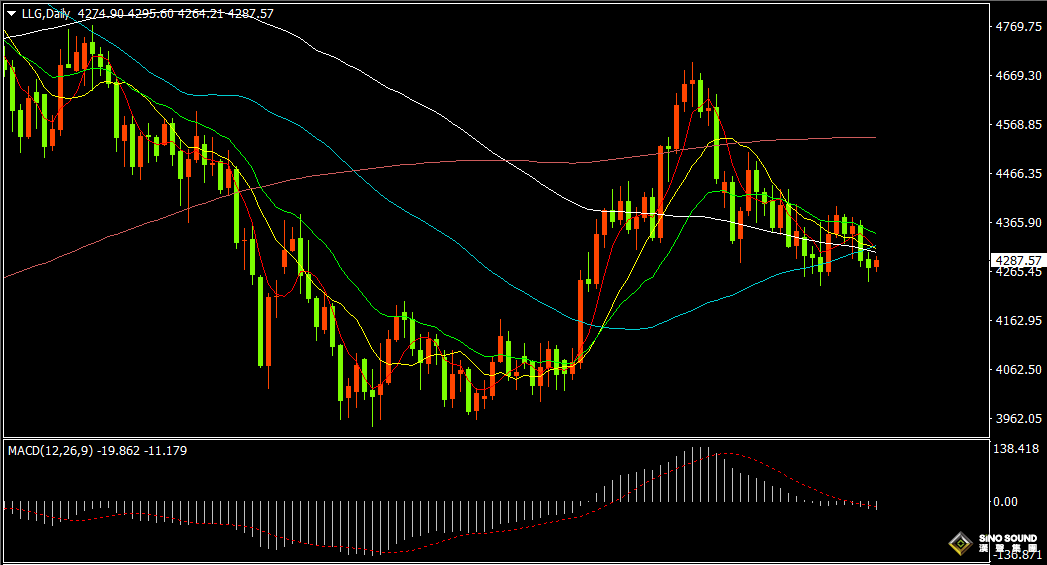
Looking at the daily gold chart, gold has posted two consecutive bearish candles. There is strong resistance to short-term rebounds. Multiple moving averages including the 5-day, 10-day, 50-day and 100-day moving averages stack up to form pressure on gold. From daily indicators, the MACD negative momentum histogram is gradually expanding, while the RSI remains flat around the 44 level.
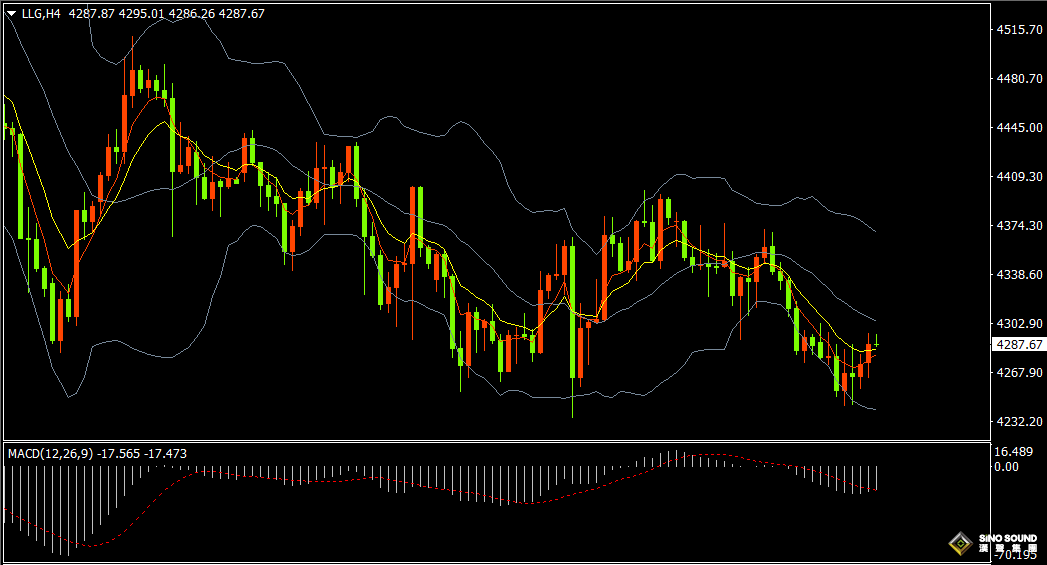
Looking at the 4-hour gold chart, the three BOLLinger Bands continue trending downwards, and gold oscillates between the middle and lower bands. The short-term EMA5 and EMA10 maintain a bearish arrangement. The MACD negative momentum histogram peRSIsts, and the RSI has rebounded slightly to around the 42 level. For short-term trading strategy, gold is expected to consolidate mainly within the range of 4245-4300. If breaking this range upwards, the targets are near 4308-4320 or 4330; the downside targets are 4238-4225 or near 4210.
Key economic data and events to watch today:
14:00 Germany October GfK Consumer Confidence Index
17:15 Fed's Williams to deliver a speech
20:30 US August Durable Goods Orders MoM
21:20 Fed's Schmid to deliver a speech
22:00 US September UniveRSIty of Michigan Consumer Sentiment Final
22:00 US September 1-Year Inflation Expectations Final
01:00 (next day) US Oil Rig Count for the week ending September 25
02:00 (next day) Fed's Mester to deliver a speech
[Disclaimer]The views and opinions expressed in this article are solely those of the author and do not necessarily reflect the views of SinoSound. SinoSound remains neutral regarding the opinions and statements contained herein and makes no representations or warranties, whether express or implied, regarding the accuracy, reliability, or completeness of the information provided.
The content of this article is intended for informational and reference purposes only. Readers should exercise their own judgment and assume full responsibility for any decisions or actions taken based on the information contained herein.
[Copyright Notice]This article is original content and is protected by applicable copyright laws. Any reproduction, distribution, citation, or use of this content must clearly acknowledge the original source:
Gold2U
www.gold2u.com
We reserve all rights and may take legal action against any individual or entity that fails to comply with this notice or otherwise infringes our intellectual property rights.