

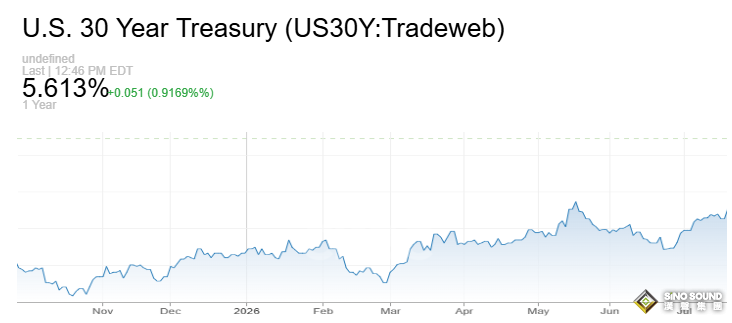
Tuesday (September 29), global financial markets were once again shrouded by the triple pressures of "high oil prices, high inflation and high interest rates". Yields on long-dated US Treasury bonds continued to surge sharply. The 30-year US Treasury yield once touched 5.613%, hitting the highest level since 2002; the 10-year US Treasury yield climbed to around 5.28%, lingering at rare highs not seen since 2007. As the market further bet on another Fed rate hike in October, the US dollar strengthened and US stocks came under pressure. Although gold staged a technical rebound after Monday’s sharp slump, its upside remains limited.
The Federal Reserve raised the target range for the federal funds rate by 25 bASIs points to 3.75%-4.00% on September 16, and emphASIzed that inflation remains elevated. The next FOMC meeting is scheduled for October 27-28.
30-Year US Treasury Yield Rises to 24-Year High
A fierce sell-off hit the US Treasury market again on Tuesday. The 30-year US Treasury yield rose about 4 bASIs points to 5.609%, peaking at 5.613% intraday, the highest level since June 2002. The 10-year US Treasury yield, one of the core benchmarks for global asset pricing, climbed roughly 4 bASIs points to 5.285%. In contrast, the 2-year US Treasury yield, more sensitive to short-term Fed policy, saw limited movement and stayed near 4.92%.
(Source: CNBC)
The sustained climb in long-term yields reflects investors re-evaluating the combined risks of US inflation, fiscal deficits, energy prices and monetary policy. Especially amid high oil prices and resilient US economic data, the market is increASIngly worried that the Fed may have to maintain a more hawkish policy stance.
<p s

tyle="line-height: 2em; margin-bottom: 25px;"> Market bets on the next rate hike have risen markedly. According to market pricing, traders put the probability of another Fed rate hike in October above 70%, sharply higher than a week ago. Meanwhile, the Fed delivered its first rate hike since 2023 in September, meaning a "higher-for-longer" interest rate environment has once again become the main trading theme for global assets.
US Stocks Hit by Fresh Sell-off, Dow Falls 345 Points at One Stage
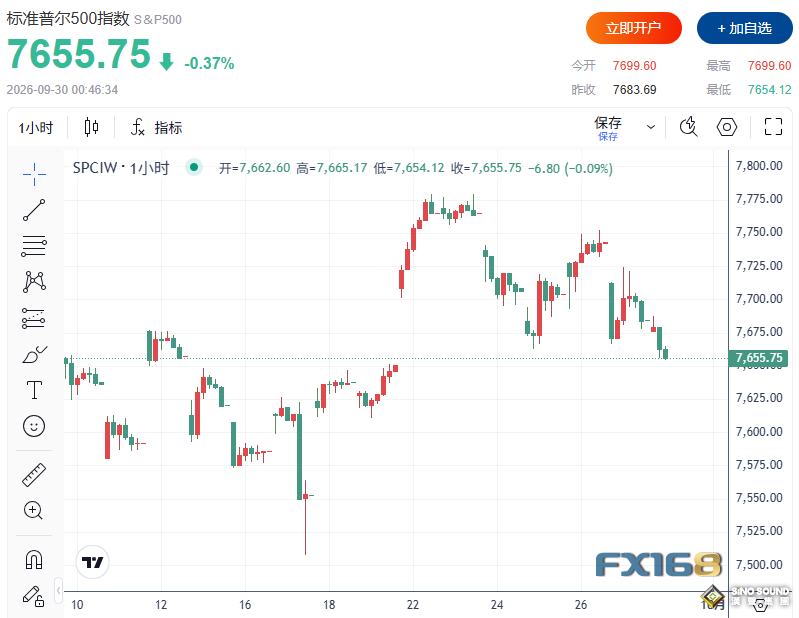
The surge in US Treasury yields quickly spilled over into US equities. During Tuesday’s session, the Dow Jones Industrial Average dropped as much as 345 points, or roughly 0.7%; the S&P 500 fell around 0.4%, and the Nasdaq Composite dipped about 0.2%. Bank stocks were among the main drags. Goldman Sachs lost roughly 1%, while JPMorgan, Morgan Stanley and Bank of America also traded lower broadly. The financial sector ETF declined approximately 0.5%.
(Source: FX168)
This marks the second consecutive trading day of notable pressure on US stocks. The Dow fell more than 300 points on Monday, while the S&P 500 and Nasdaq dropped 0.8% and 0.9% respectively. Elevated Treasury yields mean higher risk-free rates used for stock valuation, weighing heavily on high-growth stocks. At the same time, rising long-term financing costs may further suppress corporate investment, real estate activity and consumer borrowing.
Nevertheless, some institutions have not turned fully bearish. Mark Haefele, Chief Investment Officer at UBS Global Wealth Management, said investors can still prepare for further stock gains but should place greater emphASIs on diveRSIfied allocation. UBS also remains positive on fixed-income assets, though it advises investors to adjust duration according to risk tolerance and investment horizon: yield-focused investors may prefer short-duration bonds, while those who can withstand volatility can look for tactical opportunities in medium and long-term high-quality bonds.
US Dollar Rides the Rally, Euro Falls to Three-Month Low
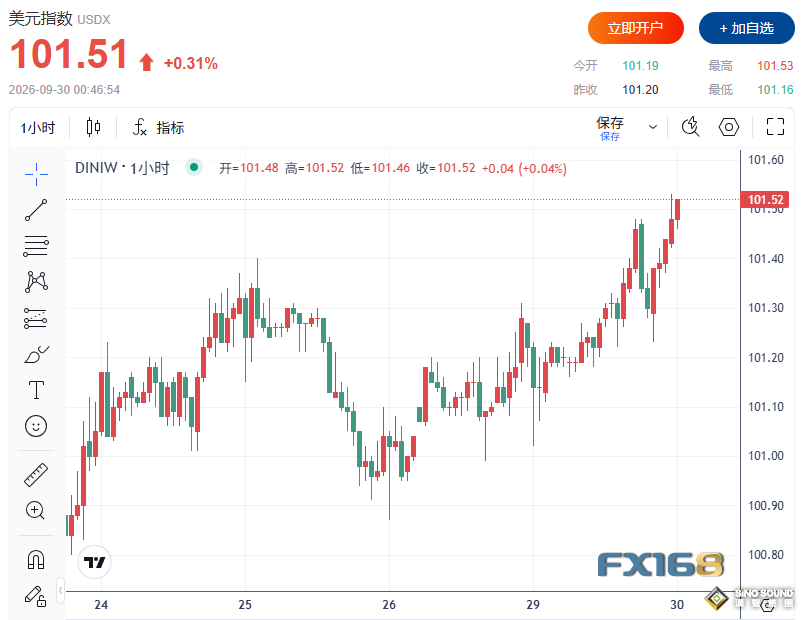
Rising bond yields also offered fresh support for the US dollar. The greenback strengthened broadly against major currencies on Tuesday. EUR/USD fell roughly 0.24% to 1.1344, touching a three-month low. GBP/USD dipped to around 1.3228, nearing the three-month trough hit last week. USD/CHF climbed to 0.8335, a roughly four-month low.
(Source: FX168)
Interest rate differentials remain the key driver behind the stronger US dollar. High energy prices, relatively robust US economic performance and reinforced market expectations for further Fed rate hikes have pushed US Treasury yields broadly higher. The 2-year yield has approached the important psychological threshold of 5%.
Morgan Stanley has also revised its outlook on the US dollar. The bank now expects the dollar to keep strengthening through the end of this year and into 2027, a stark reversal from its previous forecast that the dollar would weaken in the second half of this year. It projects EUR/USD may fall to 1.10 by mid-2027, citing widening US-EU interest rate spreads, relatively stronger US economic growth and rising European risk premiums.
US economic data due this week will act as a major catalyst for the next directional moves in the dollar and bond markets. ADP employment figures and the PCE price index will be released on Wednesday, followed by the September non-farm payrolls report on Friday. If inflation and employment data remain strong, market expectations for additional rate hikes in October and December may keep rising.
Gold Rallies 1% but Real Pressures Have Not Faded
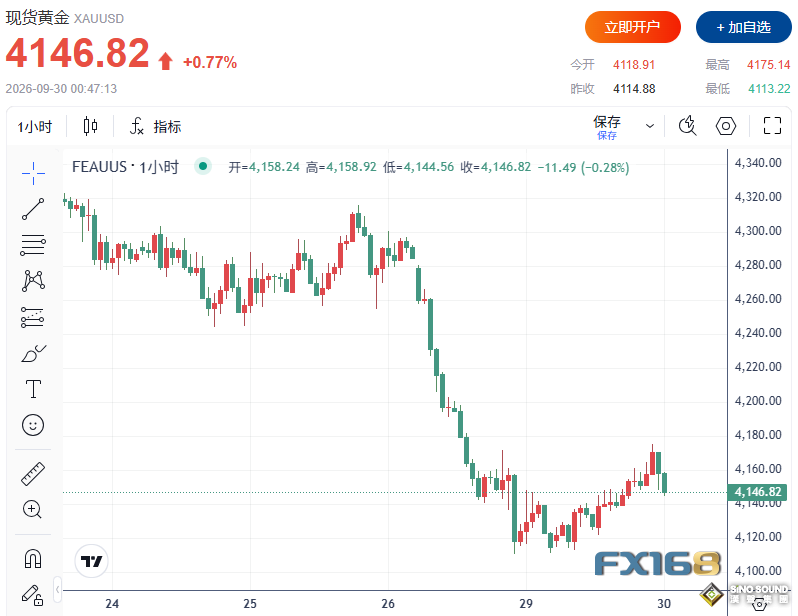
After Monday’s nearly 4% slump, gold staged a notable rebound on Tuesday. Around 9:30 AM US Eastern Time, spot gold rose about 1.1% to $4,157.39 per ounce. It hit an intraday low of $4,112.97 per ounce, only roughly $2 above Monday’s seven-week low of $4,110.55. US gold futures gained about 0.5% to $4,189.60 per ounce.
(Source: FX168)
Peter Grant, Vice President and Senior Metals Strategist at Zaner Metals, believes Tuesday’s gold gain was mostly a correction of the prior session’s losses rather than an eASIng of fundamental pressures. He pointed out that market expectations for further Fed tightening remain strong, the US dollar stays firm and Treasury yields are elevated, so gold’s upside on the day may remain capped.
Gold is currently facing a classic "double squeeze". On one hand, geopolitical risks and rising inflation can theoretically boost gold’s safe-haven and inflation-hedging demand. On the other hand, if inflation forces the Fed to hike rates further, it lifts the dollar and real interest rates, raising the opportunity cost of holding non-yielding gold. Therefore, whether gold can truly reverse the downtrend since Monday largely depends on whether upcoming PCE inflation and non-farm payrolls data can alter market expectations for the interest rate path.
Oil Prices Pull Back, but the $100 Era Is Far From Over
On the energy front, oil prices retreated on Tuesday. Brent crude futures fell roughly 1.6% to $103.60 per barrel. US WTI crude futures dropped around 2% to $90.72 per barrel. Nevertheless, oil prices remain markedly higher than for most of this year, meaning energy inflation risks have not truly disappeared.
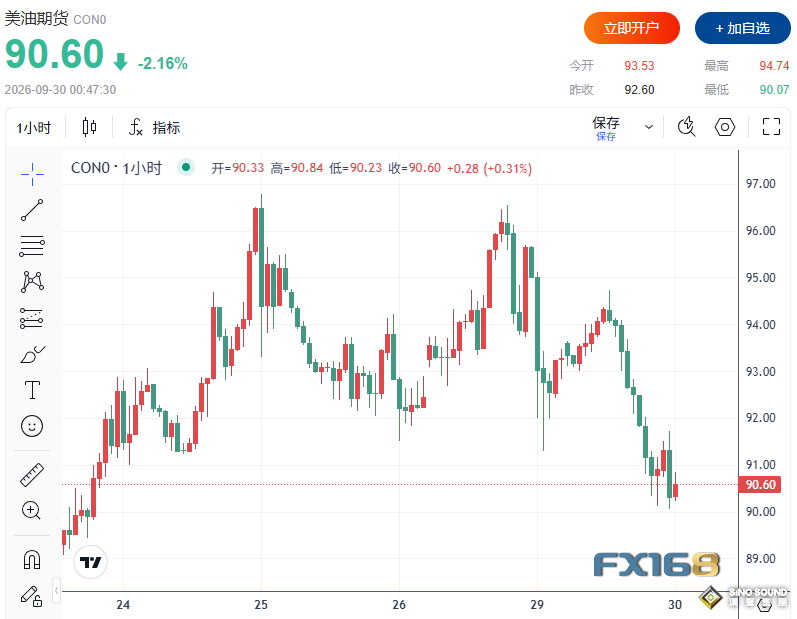
(Source: FX168)
The oil price decline was mainly driven by the resumption of Saudi exports. Satellite imagery shows a clear recovery in operations at Saudi Arabia’s Yanbu and Muajjiz terminals. From last Saturday to Monday, Yanbu loaded approximately 12.5 million barrels of crude onto nine oil tankers. Previously, a drone attack on Saudi Arabia’s east-west pipeline once stoked market fears of further tightening in global crude supply.
Saudi Arabia has restored the pipeline’s throughput to roughly 3.5 million barrels per day, compared with its maximum capacity of about 7 million barrels per day. Meanwhile, crude shipments through the Strait of Hormuz continue to recover. Data shows the seven-day average of crude oil transported via the Strait of Hormuz stands at roughly 13.2 million barrels per day, equivalent to around 77% of the 17 million barrels per day seen before the US-Iran war broke out.
Still, the market remains highly alert to geopolitical developments. The US and Iran continue contacts through mediators, but US President Trump rejected Iran’s earlier conditions for reopening the Strait of Hormuz. Hence the market still doubts whether a ceasefire or full restoration of energy shipments can be achieved in the short term. Against this backdrop, even if oil prices pull back in the near term, geopolitical risk premiums may peRSIst for a long time.
"High Oil Prices + High Interest Rates" Become the Biggest Risk for Global Markets
An increASIngly clear trading chain is forming across global markets: Middle East conflicts and energy supply uncertainty push up oil prices, which in turn fuel inflation concerns. Inflation pressures prompt investors to bet on additional Fed rate hikes, driving US Treasury yields and the dollar higher, ultimately weighing on US stocks, gold and other risk assets.
This combination makes markets particularly nervous because hedging relationships between traditional assets are becoming complicated. Normally, falling stocks tend to draw capital into Treasury bonds and gold for safe haven. But currently, Treasury bonds themselves are being sold off with yields surging, while gold is pressured by the dollar and high interest rates. Investors can hardly rely on the simple strategy of "buy bonds when stocks fall, buy gold for safety" to cope with market volatility.
Going forward, the PCE inflation, ADP employment and non-farm payrolls reports will be critical to determine whether this trading logic peRSIsts. If US economic data remains strong, the market may further raise bets on Fed rate hikes in October and even December. US Treasury yields and the dollar still face upside risks. Conversely, a marked cooling in data could temporarily ease pressure in the bond market and offer breathing room for gold and US stocks.
For global markets, the real focus right now is no longer simply whether oil prices fall back below $100, but whether high energy prices, heavy fiscal pressures and high interest rates can peRSIst simultaneously. Once these three factors keep resonating, the repricing process of global assets may be far from over.