

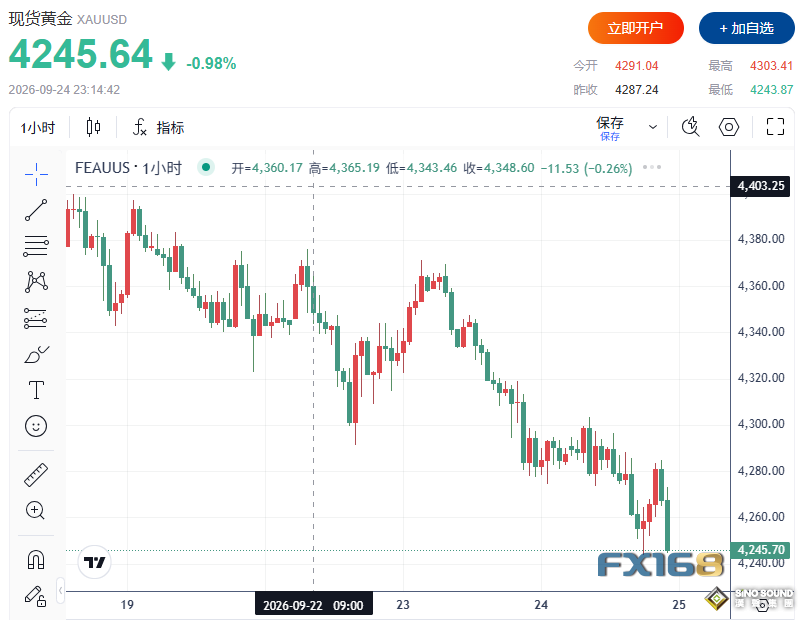
During early US trading hours on Thursday, both spot gold and silver weakened, with silver suffering a larger decline. While safe-haven demand stemming from the US-Iran conflict remains in place, rebounding oil prices, rising US Treasury yields and growing market expectations for further Fed rate hikes are offsetting the safe-haven support for precious metals. As of press time, spot gold dipped to a low of $4243.87 per ounce, down roughly 1% on the day; spot silver traded at $63.054 per ounce, falling more than 2%.
(Source: FX168)
Inflation Pressures Heat Up Again
Market pricing for the interest rate path turned more hawkish on Wednesday. The US S&P PMI for September showed that private-sector activity expanded at its fastest pace in more than five years, and input cost pressures intensified notably amid rising energy costs. The US initial jobless claims for the prior week released later fell to 197,000, below the market expectation of 204,000, showing the labour market foundation remains solid enough to support hawkish Fed pricing. Interest rate futures currently imply around a 70% probability of a 25-bASIs-point rate hike in October.
Meanwhile, the US Dollar Index stayed near 101.05, and the 10-year US Treasury yield hovered around the 5.1% level. Traders are waiting for more data to verify economic resilience: US August durable goods orders will be released at 8:30 ET on Friday, and the final September consumer confidence reading will come out at 10:00 ET. If housing, orders or inflation expectation data continue to beat forecasts, gold may remain under pressure, as higher yields and a stronger dollar usually reduce the appeal of non-interest-bearing assets. Conversely, weaker data may test whether the recent selloff in precious metals has overpriced the Fed’s policy path.
Hormuz Risk Premium Returns to Crude Oil
Geopolitically, the risk premium related to the Strait of Hormuz has returned to the crude oil market. Previous US-Iran negotiations made little progress. Iran is reviewing Washington’s response proposal, which prioritizes lifting US maritime blockades on Iranian ports and reopening the Strait of Hormuz. Iranian security officials stated that the strait will not reopen until Tehran’s conditions are met.
Affected by this, Brent crude hovered at $104.71 per barrel and WTI crude traded near $93.53 per barrel. The rebound in oil prices amplifies inflation shocks and transmits further to the gold market via yields and the US dollar. Although gold still obtains certain geopolitical support, the current market transmission chain mainly centres on crude oil, inflation expectations, US Treasuries and the US dollar.
US Stock Futures Weaken
Global stock markets were generally risk-averse before the US market opened. Wall Street stock futures declined amid higher energy prices, uncertainty over the Middle East situation and the US-China presidential summit. At 07:32 Beijing time on Thursday, Dow futures dropped 151 points, or 0.29%; S&P 500 futures fell 40 points, or 0.51%; Nasdaq 100 futures lost 278.5 points, or 0.91%.
Previously leading AI-related stocks were also among the pre-market losers. With crude oil climbing, airline and cruise operator shares also weakened. Market participants said that if oil prices remain elevated, risk appetite may face further pressure, which in turn affects precious metals and the US dollar via stock market sentiment.
Gold and Silver Technical Levels
From a technical perspective, the next target for spot gold bulls is to reclaim the resistance zone of $4312.07 to $4319.60 per ounce. A sustained breakout would open the next target at $4347.26 and further towards $4399.67. For bears, a break below $4235.17 would send gold down to $4230.51, and then to $3996.06. The primary resistance stands at $4312.07, followed by $4319.60; the primary support is at $4235.17, then $4230.51.
For spot silver, bulls need to push prices back above the $66.4745 to $68.6390 zone to reverse the downtrend. A successful breakout would send the metal higher to $71.9215 and the psychological level of $72.000. The next target for bears is a break below $63.1920, followed by $62.0740 and the $60.000 to $58.7915 range. Silver’s primary resistance is $66.4745, then $68.6390; primary support sits at $63.1920, then $62.0740.
Overall, the core driver of precious metal prices has shifted from pure safe-haven demand to the linkage of oil prices, inflation expectations, US Treasury yields and the US dollar. If subsequent economic data reinforce hawkish Fed expectations, short-term pressure on gold and silver may peRSIst. If data weakens or geopolitical risks flare up again, precious metals may regain support.