

How to read today's live London gold market? Recently, safe-haven buying driven by geopolitical conflicts in the Middle East has supported gold prices. Meanwhile, rising oil prices have lifted inflation expectations and reinforced expectations that the Federal Reserve will maintain high interest rates, putting counter pressure on gold prices. These two forces pull against each other and amplify volatility on gold charts. For ordinary traders, simply following price swings and news-driven trading can eASIly lead to poor timing and frequent losses.
In practical trading, moving averages are classic trend indicators with strong applicability and high fault tolerance. They can effectively filter short-term market noise and identify the main trend direction. By mastering the bASIc usage of moving averages and setting entry and exit rules based on multi-period moving average combinations, traders can build a standardized trading system, get rid of subjective emotional judgments, and steadily capture reliable trading gains amid alternating ranging and trending markets.
I. BASIc logic for applying moving averages
Moving averages reflect the average market holding cost over a certain period and serve as a fundamental tool to analyze the trend of London gold. Simply put, when gold prices trade above the moving average, the market is generally bullish; when gold prices trade below the moving average, the market tends to be bearish. Moving averages also act as support and resistance. Gold prices often rebound when pulling back to the moving average level, while price rallies are prone to retreat when blocked by moving averages. However, note that a single moving average tends to generate false signals. Therefore, it is not recommended to use it alone in actual trading; a combination of moving averages is required for comprehensive market analysis.
II. Finding entry opportunities with moving average combinations
In practical trading, investors can combine short-term and medium-term moving average combinations to spot entry signals. Short-term moving averages capture market momentum, while medium-term moving averages confirm trend direction. A bullish crossover (golden cross), where the short-term moving average crosses above the medium-term moving average and gold price stabilizes above the moving average cluster, serves as a bullish entry reference signal. Conversely, a bearish crossover (death cross), where the short-term moving average crosses below the medium-term moving average and gold price trades under the moving average cluster, can be taken as a bearish reference signal. In a clear trending market, gold price pullbacks that gain support at moving averages are also important opportunities to trade with the trend. Resonance of multiple moving average signals can filter substantial noise and improve signal reliability.
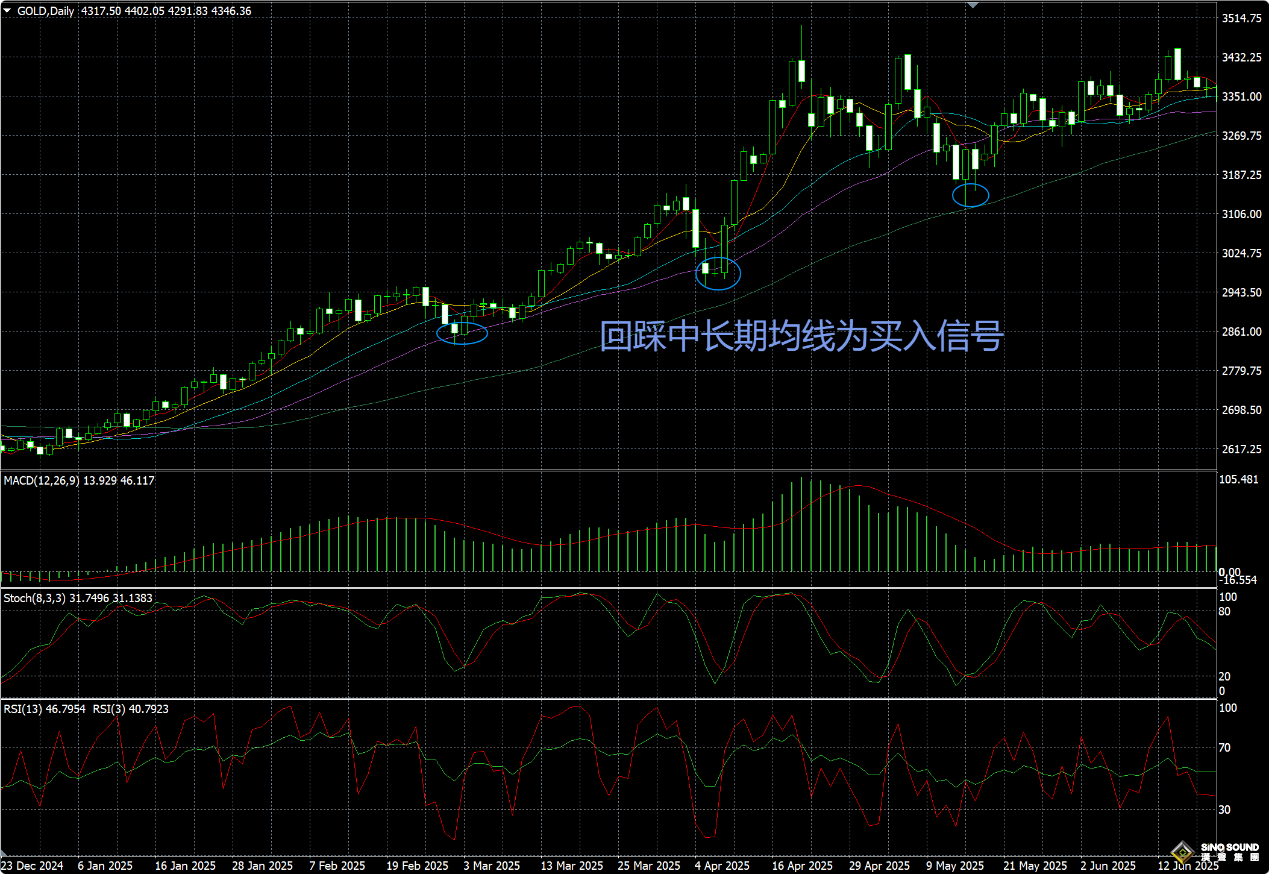
III. Using moving average combinations to manage exits and control trading risks
Besides identifying entry points, moving average combinations can also be used as exit references. For trend-following positions, long positions can be held as long as moving averages maintain a bullish arrangement and gold price has not effectively broken below the key medium-term moving average. Once the short-term moving average turns downward to form a death cross, or gold price breaks below the medium-term moving average effectively, it indicates weakening momentum of the original trend, and profit-taking exit can be considered. In ranging markets, moving averages cross repeatedly. Under such circumstances, trading frequency should be reduced to avoid frequent stop-losses. Setting exit rules based on moving averages can reduce subjective guesswork and enable planned trading.
In summary, for today's chart movements in the live London gold market, the moving averages available in the MT4 platform provided by Sino Sound are practical tools for analysis and response. By mastering the bASIc usage of moving averages and making good use of moving average combinations to identify entry and exit signals, investors can cut down emotional trading, better cope with market volatility and pursue more stable trading returns.
[Copyright Notice]This article is original content and is protected by applicable copyright laws. Any reproduction, distribution, citation, or use of this content must clearly acknowledge the original source:
Gold2U
www.gold2u.com
We reserve all rights and may take legal action against any individual or entity that fails to comply with this notice or otherwise infringes our intellectual property rights.