

Spot gold remained under pressure during Thursday’s ASIan session. The price once dipped toward $4265 before rebounding back above $4300. Gold had climbed to $4365.57 on September 16, but after the Fed announced the rate hike and Chairman Kevin Warsh delivered hawkish signals at the press conference, gold quickly erased its gains and fell to nearly $4240 intraday, down more than 1% for the day.
The Fed raised the target range for the federal funds rate by 25 bASIs points to 3.75%–4.00%, its first rate increase since July 2023. More noteworthy to the market, the latest economic projections show most policymakers expect room for further rate hikes this year, with the median year-end rate forecast at roughly 4.1%. This means part of the bullish gold narrative built around expectations of eASIng policy is being repriced, and the high-rate environment may peRSIst for longer.
In terms of policy statements, inflation remains one of the Fed’s top policy considerations. Warsh stated that recent inflation readings have not shown sufficient improvement in underlying price pressures and emphASIzed the Fed still needs to deliver price stability. The market has therefore paid greater attention to the prospect of further rising financing costs, lending support to the US dollar and keeping Treasury yields elevated. The 10-year Treasury yield previously broke above 5%, further lifting the opportunity cost of holding non-yielding gold.
The synchronized strength of the US dollar and yields is the key direct factor behind this pullback in gold. Gold bears no interest income. When US Treasury yields rise, the opportunity cost borne by investors holding gold increases accordingly. Therefore, with the Fed signaling further monetary tightening, gold cannot fully escape pressure from the US dollar and real interest rates even amid global safe-haven demand.
Nevertheless, gold is not driven solely by bearish factors. Middle East tensions and peRSIstently high energy prices may still bolster safe-haven demand and influence global rate markets via inflation expectations. Crude oil remains above $100 in particular, and energy costs have again become a major variable for the inflation outlook in the US and worldwide. A further rise in oil prices that pushes inflation expectations higher may lead the market to price in a longer high-rate environment. At the same time, escalating geopolitical risks could boost allocation demand for gold as a safe haven, resulting in obvious tug-of-war between bulls and bears for gold prices.
Market focus on gold has thus shifted from simple “rate-cut trading” to a comprehensive game involving interest rates, the US dollar, yields and safe-haven demand. Gold’s sustained high level previously benefited largely from fiscal risks, geopolitical risks and inflows of safe-haven capital. Now that the Fed’s policy direction has changed, the balance between these supporting factors and high-rate pressure is being readjusted.
From the perspective of short-term capital sentiment, gold surged rapidly before the Fed decision and then pulled back sharply, showing some long funds chose to take profits after the policy announcement. Data shows spot gold tumbled quickly from the intraday high near $4365 to around $4240, indicating the $4300 round level has transformed from a previous price center into a critical battleground for bulls and bears.
Going forward, key attention should be paid to the US Dollar Index, US Treasury yields, US inflation data and subsequent remarks by Fed officials. If the US dollar continues to strengthen and long-end yields stay high, gold’s room for short-term rebounds may be limited. If yields retreat while geopolitical risks heat up again, gold may regain support from safe-haven capital. Meanwhile, whether crude oil prices remain elevated will also affect gold’s medium-term trend through inflation and monetary policy expectations.
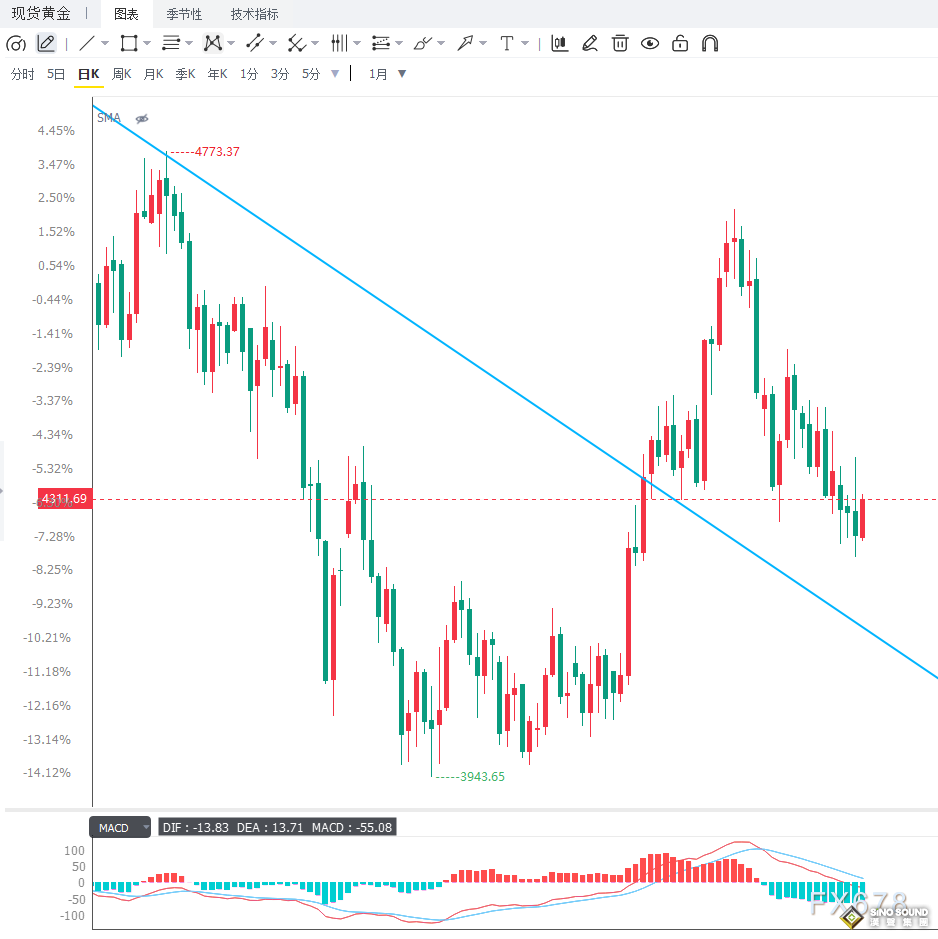
On the daily chart, spot gold surged to near $4365 and then fell quickly, returning to $4300 and still trading within a range in the short run. The current price sits below the 100-day moving average, and the technical picture remains in adjustment. The Relative Strength Index (RSI) stands at roughly 42 and has not entered deep oversold territory, meaning there is still room for further selling pressure. The first resistance above is near the 100-day MA at $4330, which has become an important barrier for short-term rebounds. Further up lies the middle band of the BOLLinger Bands around $4440; only reclaiming this zone can the weak daily structure see notable improvement. On the downside, focus is on the lower BOLLinger Band near $4200. A break below $4200 may send gold seeking further support at $4150 or even $4100.
On the 4-hour timeframe, gold peaked near $4365 and then declined rapidly. The short-period moving average structure has turned weak, and market momentum favors bears. The $4300 zone is a key observation area during this correction. If price can climb back above $4330, it suggests short-term selling pressure is eASIng, and gold may rebound toward $4360 afterward. If rebounds keep stalling below $4330 while the $4200 support is breached effectively, further downside space may open on the 4-hour chart. Overall, the short-term technical structure remains bearish, yet there is some buying interest near $4200, so traders chASIng short positions need to watch out for technical rebounds.
The Fed raised interest rates again after a three-year hiatus and signaled potential further tightening this year, making the US dollar and Treasury yields major forces weighing on gold again. After breaking below $4300, gold did not show a decisive breakdown and maintained range-bound trading. However, geopolitical risks, fiscal concerns and safe-haven demand may still slow gold’s decline. The key to gold’s future trend depends not only on whether the Fed continues hiking rates, but also on whether inflation, oil prices and Treasury yields can form sustained upward pressure. $4200 and $4330 will serve as important short-term observation levels, while reclaiming $4360 will be a key signal to judge whether gold can end the current correction.