

After the Fed’s first rate hike in three years, Chairman Kevin Warsh further explained the logic behind this policy shift at the press conference. He stated plainly that the US economy had strengthened further compared with the July meeting, summer inflation data failed to show satisfactory improvement, and the geopolitical environment had also changed. These three factors combined led the FOMC to unanimously approve a 25-bASIs-point rate hike by a 12-0 vote.
Compared with July, the Fed not only shifted from holding rates steady to an official rate hike, but the policy statement and dot plot also delivered more hawkish signals. The latest projections show that among the 18 officials submitting rate forecasts, 16 believe at least one more rate hike will be needed within this year. Warsh also emphASIzed that "inflation is too high and has lasted too long", and the Fed’s current policy focus is shifting more toward price stability.
The market then repriced assets. The US Dollar Index broke above the 100 threshold, spot gold fell roughly $100 from its intraday high, and major US stock indices turned under pressure after remaining relatively stable in the immediate aftermath of the decision release.
Why No Hike in July but a Unanimous Hike in September? Warsh Offers Three Reasons

When asked why the policy stance changed within just a few weeks, Warsh said data since the July meeting indicated the US economy was strengthening, with improvements in indicators including the labor market, private-sector income and corporate capital investment.
"A fairly broad range of data, including the labor market, suggests the economy has strengthened," Warsh said. This is his personal judgment and the shared conclusion of the FOMC committee.
But while the economy grew stronger, inflation failed to improve to the Fed’s satisfaction. Warsh said summer inflation trends "did not pass the test", and little new information he had seen since then changed this assessment.
The third change came from geopolitics. Warsh stated that the Fed’s assessment of the most probable and least probable geopolitical outcomes had shifted. Though he did not name specific conflicts during the Q&A session, he explicitly cited geopolitical shifts as a key factor influencing this policy decision.
Warsh summarized that stronger economic performance, stubborn inflation and revised geopolitical judgments "together brought about today’s firm and unanimous decision".
This marked a stark contrast to the July meeting. Back in July, the FOMC kept the federal funds rate at 3.50%-3.75% with a 9-3 vote, where three officials already advocated an immediate 25-bASIs-point hike. The Fed’s July statement still linked part of the inflation pressure to supply shocks in sectors such as energy. (CNBC)
"Inflation is too high, and it has lasted too long"
If a stronger economy created room for the Fed to raise rates, peRSIstently elevated inflation was the direct trigger for this move.
In his opening remarks, Warsh said the US economy "appears to be strengthening", with non-farm payrolls, private-sector income and corporate capital investment improving in recent months, and the labor market generally in good shape.
But he quickly shifted focus to price stability.
"The simple fact is inflation is too high, and it has lasted too long," Warsh said. The Fed’s primary attention now rests on its price stability mandate. He noted summer inflation data did not convince him that underlying inflation trends had made meaningful improvement, and too many categories in recent CPI and PPI readings maintained gains above 3% on both 6-month and 12-month horizons.
This remark echoed changes in the latest FOMC statement. Compared with July, the September statement removed the prior explanation linking inflation to "supply shocks" in energy and other sectors, retaining only the wording that "inflation remains elevated", and further clarified: "Today’s policy action will support a more timely return of inflation to the Committee’s 2 percent objective."
This wording adjustment means the Fed’s current focus is no longer merely the source of price increases for a single commodity, but whether these price shocks will spill over into broader segments of the economy.
Rate hikes cannot bring down oil prices, but the Fed must prevent inflation "spillover"
Warsh also responded to questions about whether rate hikes can truly resolve inflation caused by energy supply issues.
He acknowledged the Fed cannot directly affect the price of any specific commodity, whether crude oil or food sold in supermarkets. But what the Fed can and will do is prevent relative price changes from further "spilling over" and generating second-round or even third-round effects across the whole economic system.
This further explains the Fed’s current policy logic: rate hikes cannot directly boost crude oil supply or bring energy prices down immediately. However, if rising energy costs gradually pass through to transportation, food, manufacturing, services, wages and inflation expectations, monetary policy must stop one-off price shocks from evolving into more peRSIstent, widespread inflation.
Therefore, the Fed’s removal of the "supply shock" wording does not mean it denies the impact of energy and geopolitics on inflation. Instead, it shows the FOMC is increASIngly focused on the risk of these shocks spreading to the overall price system.
Hawkish Dot Plot: 16 out of 18 officials expect another hike this year
Compared with the policy statement, the latest dot plot sent an even more direct signal.
Among the 19 policymakers, 18 submitted rate projections, consistent with June. Of these, 16 believe at least one more rate hike will be needed in 2026 after this increase, while only 2 think rates can stay unchanged after the current hike.
Specifically, four officials expect a total of 75 bASIs points of rate hikes for 2026, up from just one in June; 12 officials forecast cumulative hikes of 50 bASIs points, compared with five in June; another two expect total hikes of 25 bASIs points.
A more notable shift: back in June, eight officials expected rates to remain flat for the whole year and one predicted a 25-bASIs-point cut. In the latest projections, neither view remains.
Based on the dot plot median, the Fed expects another 25-bASIs-point hike in 2026, lifting the policy rate to 4.00%-4.25%, and this level will be maintained through the end of 2027. Rate cuts are not projected to begin until 2028, with rates settling in the 3.50%-3.75% range in 2029.
The Fed also raised its long-run federal funds rate estimate from 3.1% to 3.2%, and inflation forecasts for this year and subsequent years were revised higher overall.
Warsh himself most likely did not submit specific rate point projections, consistent with his practice in June.
Why US Treasury yields keep rising? Warsh names three reasons
The recent rally in US Treasury yields also became a focal point at the press conference. Warsh attributed the trend to three main factors.
First, the underlying strength of the US economy. More resilient growth means market expectations for rapid rate cuts have diminished, making higher interest rates eASIer to sustain.
Second, competition for capital is intensifying. Warsh specifically noted the surge in corporate capital expenditure is real. When enterprises and other economic agents demand more funding, competition for capital across different uses intensifies, putting upward pressure on long-term financing costs.
Third, geopolitics. Rising global geopolitical risks alter investors’ assessments of future growth, inflation and fiscal risks and may demand higher risk compensation.
Thus, under Warsh’s framework, the recent rise in yields is not driven by a single factor, but the combined effect of strong economic performance, growing capital demand and geopolitical risks.
When asked about Trump, Warsh: "I have nothing to tell you"
Another closely watched topic at the press conference was the relationship between the Fed and the White House.
When reporters asked Warsh what message he had for President Trump, who had repeatedly advocated lower interest rates, and when he last discussed the matter with Trump, Warsh declined to disclose the content of their exchanges.
"I have nothing to tell you about my discussions with the President," Warsh stated.
When reporters followed up and asked whether investors should view this rate hike as a test of Fed independence, Warsh again emphASIzed he would not discuss private conversations with the president, adding: "I am not a Wall Street newsletter."
He then offered a clearer principled statement: "Part of Fed independence is that we do what falls within our mandate."
Warsh further stated that "independence works both ways". Those responsible for trade and fiscal policy should also operate within their respective mandates, while the Fed makes monetary policy decisions based on its own judgment.
This marked one of Warsh’s more direct responses on the issue of Fed independence. He did not comment on the White House’s interest rate proposals themselves, focusing instead on institutional boundaries.
Christopher Phelan, Chair of the White House Council of Economic Advisers, previously told CNBC he believed the current rate hike would be a "mistake". Warsh stressed that the rate hike was enacted to fulfill the Fed’s congressional mandate of ensuring price stability.
He described the rate hike as a "calm", "serious" and "responsible" decision, while refusing to prejudge actions to be taken at future meetings.
Warsh specifically mentioned low-income groups: stable prices are especially important
Warsh also spoke about economically vulnerable groups in the United States during the press conference.
He said those with the most limited financial means benefit the most from sustained economic expansion, a robust labor market and stable prices.
This remark further explains why Warsh repeatedly stresses price stability. High inflation impacts different income groups unevenly. Necessary spending on food, energy, housing and transportation usually accounts for a larger share of low-income households’ outlays, so peRSIstent price increases can create far more acute pressure on real purchASIng power.
From Warsh’s remarks on the day, the Fed hopes to prevent inflation from staying above target for a long time while preserving employment growth and economic expansion.
Market repricing: Another December hike becomes the base case
As Warsh kept emphASIzing inflation risks, interest rate markets adjusted rapidly.
According to immediate pricing from the CME FedWatch Tool after the decision, the market priced roughly a 59.5% probability that rates would stay unchanged at 3.75%-4.00% at the October meeting, a 40.1% chance of a 25-bASIs-point hike and a 0.5% probability of a 50-bASIs-point increase.
For December, the probability of rates remaining at current levels fell to 16.7%; the chance of a further cumulative 25-bASIs-point hike stood at about 54.0%; cumulative 50-bASIs-point hikes were priced at roughly 28.9%; and cumulative 75-bASIs-point hikes at 0.3%.
It should be noted that these probabilities come from real-time futures market pricing and will fluctuate with inflation, employment, energy prices and geopolitical news; they do not represent policy commitments from the Fed.
Gold plunges $130 from intraday high, US dollar breaks above 100
The market reacted far more sharply to Warsh’s press conference than to the initial rate decision announcement.
The US Dollar Index once rose more than 0.6% to 100.25, hitting its highest level since July 31; EUR/USD fell roughly 0.2% to near 1.1517. Rising expectations for further rate hikes supported the US dollar.
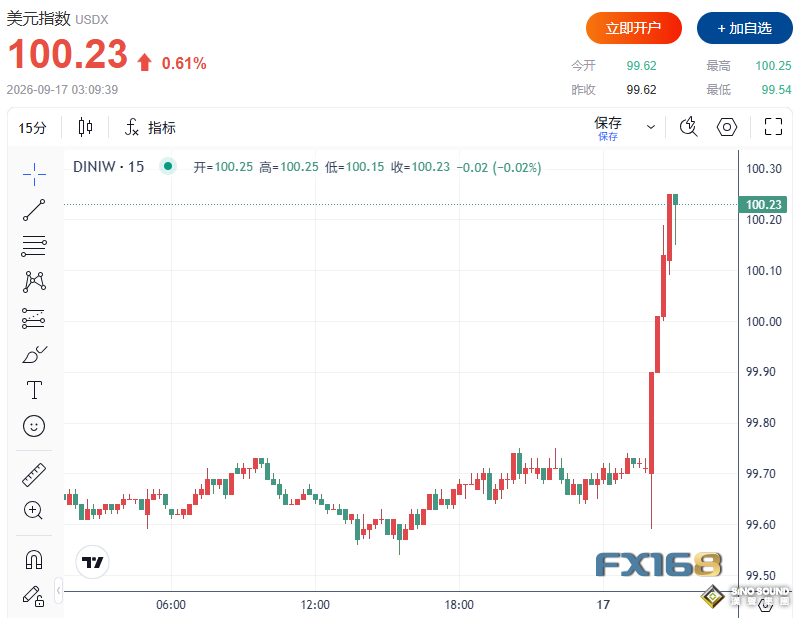
(Source: FX168)
Gold came under heavy pressure. Spot gold tumbled $130 from its intraday peak and broke below $4240 per ounce, with an intraday loss exceeding 1.25%. Higher interest rates and US Treasury yields normally raise the opportunity cost of holding non-yielding gold, and a stronger US dollar added further downward pressure on gold prices.
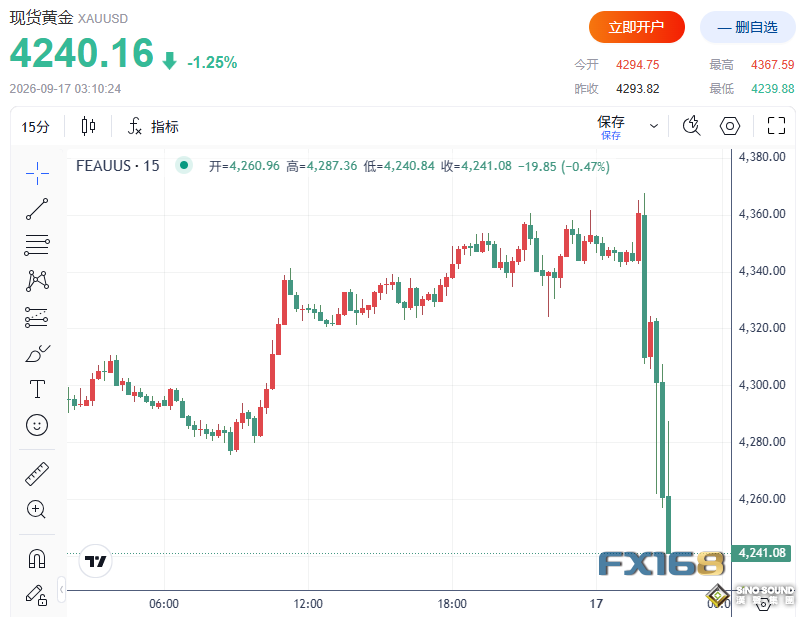
(Source: FX168)
US stocks also reversed early gains and headed lower. The Dow Jones Industrial Average dropped roughly 700 points at one stage, down around 1.3%; the S&P 500 fell approximately 0.7%, and the Nasdaq Composite lost 0.3%.
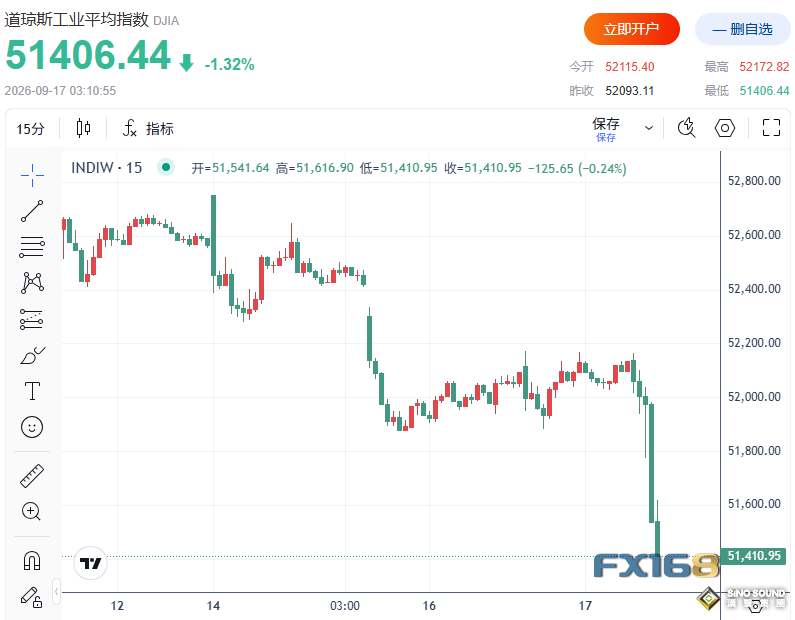
(Source: FX168)
This price action shows the market initially reacted only mildly to the 25-bASIs-point hike itself because the decision had been well priced in beforehand. What drove further asset repricing was Warsh’s series of remarks that "inflation is too high and has lasted too long", the strengthening economy and his refusal to preset a policy path for the future.
Shifting from "Will they hike?" to "How many more hikes are coming?"
Taken together, the policy statement, dot plot and Warsh’s press conference reveal that the policy signals from the September Fed meeting differ markedly from July.
In July, the Fed was still assessing supply shocks and economic uncertainty and voted 9-3 to hold rates steady. By September, the FOMC delivered a unanimous 12-0 rate hike, removed the "supply shock" explanation, placed greater emphASIs on price stability, and 16 officials projected at least one additional rate hike before year-end.
Warsh’s logic is clear: the economy is stronger than in July and can therefore withstand higher interest rates; inflation has not improved sufficiently; meanwhile, geopolitical risks are altering inflation and financial market conditions.
Accordingly, the market’s focus going forward is no longer whether the Fed will restart rate hikes, but when the next hike will arrive, how high rates will ultimately go, and how long this high-rate environment will peRSIst.